Snap has officially unveiled Snap OS 2.0, the latest update to the operating system powering its Spectacles. This software is not only the backbone of Snap’s hardware but also a preview of the consumer-focused experiences that will define the company’s 2026 launch of its first mass-market smart glasses.
For more than a decade, Snap has been working towards a new kind of computer — one that is not confined to desks or smartphones but instead is worn like a natural extension of daily life. Spectacles represent the continuation of that vision, merging digital and physical worlds while allowing people to interact using the same gestures, voices, and social behaviours they already rely on in everyday life.
The average person spends more than seven hours a day looking at screens. Meanwhile, artificial intelligence is changing how people interact with technology, moving from manual organisation of files and apps to higher-level guidance of intelligent agents. At the same time, the costs and environmental impact of manufacturing physical products continue to rise. Snap positions Spectacles as a response to these challenges, offering eyes-up computing powered by an AI-native operating system, with the potential to reduce waste by replacing physical goods with digital equivalents.
Beyond Apps: An AI-Native Experience
Unlike other approaches that attempt to compress smartphone-style apps into glasses, Snap OS represents a deliberate break from that model. Spectacles are designed as an AI-first computing platform, providing personalised, contextual, and social experiences.
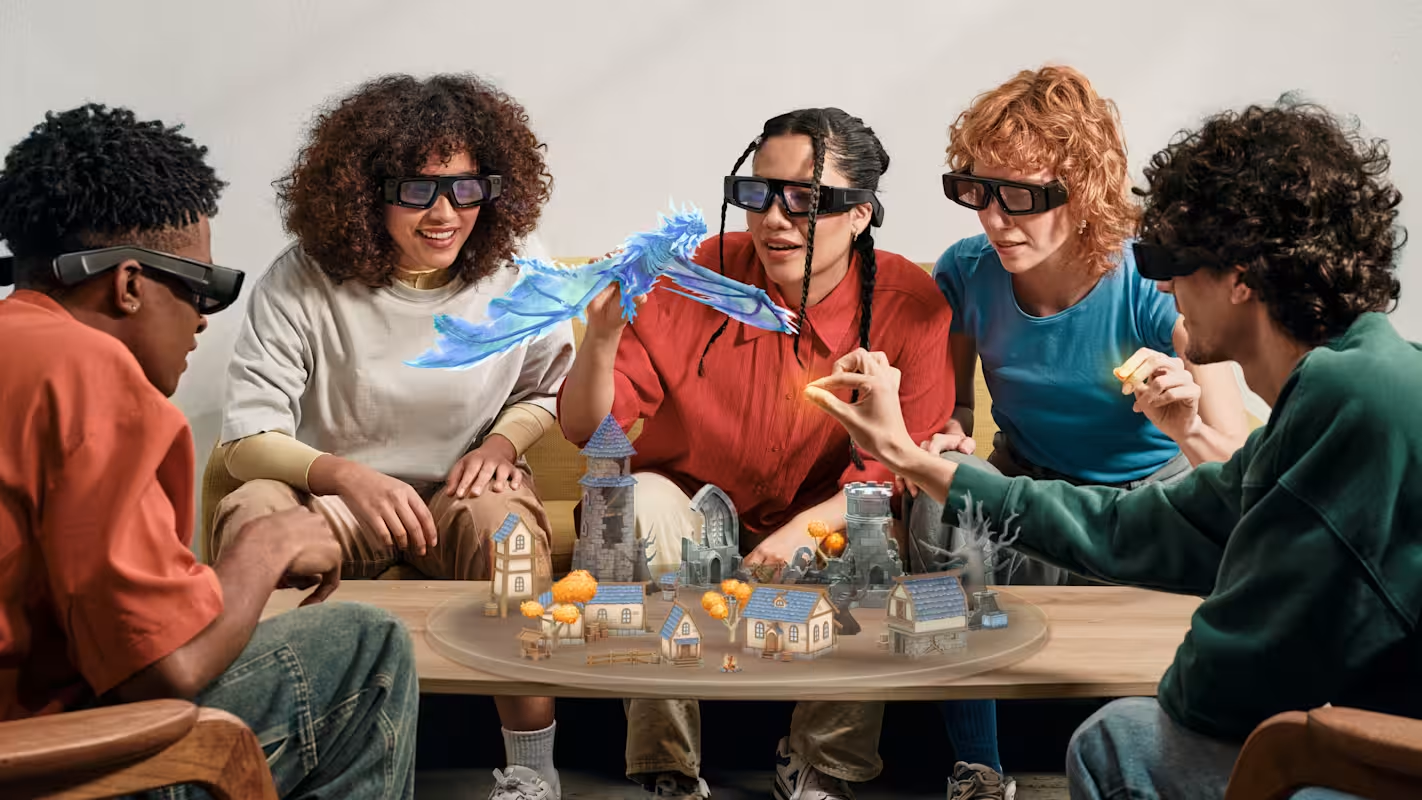
Rather than opening an app, users might simply ask to see a document from last week, or pull up a private, virtual cinema screen that only they can view. Professionals could collaborate on life-size prototypes using 3D overlays, while children could explore virtual cadavers during biology lessons. Friends might gather around a physical table to play chess on a virtual board, blending tangible social interaction with digital play.
This approach makes computing inherently social rather than solitary. Shared experiences, anchored in the physical world, become a core part of the design. By freeing users from small screens, Spectacles promise to integrate computing more naturally into real-world interactions.
Snap also emphasises the long-term business potential. A single pair of glasses could replace multiple screens, while the operating system — personalised with memory and context — gains value as it adapts to the user over time. A global marketplace for digital goods, from spatial Lenses to virtual productivity tools, could operate with near-zero marginal cost. Snap frames this transition as moving beyond the saturated smartphone market into a once-in-a-generation opportunity for human-centred computing.
What’s New in Snap OS 2.0
The release of Snap OS 2.0 introduces several upgrades designed to make Spectacles more powerful, intuitive, and useful in daily life.
The Spectacles Browser has been completely redesigned with a minimalist interface, faster loading, and greater power efficiency, reflecting Snap’s focus on balancing performance with all-day usability.
A dedicated Spotlight Lens now allows content to be projected onto the real world in a larger-than-life format, creating an immersive experience without needing a phone. This continues Snap’s focus on anchoring digital experiences spatially, rather than simply replicating flat screens in front of the user’s eyes.
The Gallery Lens introduces a new way to relive and manage captured content. Users can scroll through a carousel of videos taken with their Spectacles, zoom in on details, organise favourites, and quickly share clips to Snapchat or directly with friends. This Lens highlights the seamless link between capturing moments and sharing them socially.
Snap OS 2.0 also expands into entertainment with Synth Riders, a rhythm-based mixed reality game. Players move to the music, catching notes and avoiding obstacles while still remaining present in the real world with the people around them. By blending immersive gameplay with physical surroundings, Snap is reinforcing its idea of Spectacles as social devices rather than isolating headsets.
AI-Powered Lenses for Everyday Life
Snap is also highlighting the growing role of artificial intelligence in everyday Spectacles experiences. Several new AI-driven Lenses are rolling out this summer, showing the direction of the platform.
Spatial Tips acts as a contextual assistant, answering questions about whatever the user is looking at and delivering information directly within their field of view. This makes the AI feel integrated into the physical environment rather than an abstract chatbot on a screen.
Super Travel focuses on practical needs for global travellers, enabling real-time translation of menus, signs, and receipts, along with currency conversions. In effect, it turns Spectacles into a personal tour guide anchored in the real world.
Translation pushes this further by transcribing speech into text across more than 40 languages, while also generating closed captions in the user’s native tongue. This can make face-to-face communication across language barriers more natural, helping to reduce friction in both social and professional contexts.
These capabilities position Spectacles as more than just a device for entertainment or novelty; they are pitched as serious tools for productivity, education, and communication. By embedding AI into the operating system, Snap is building a platform that grows more powerful as AI capabilities evolve. They’re not the sleekest looking wearable glasses we’ve seen, but if yo ulike thick framed statement glasses you’re in for a treat!

Looking Ahead to 2026
Snap is positioning Spectacles not as an experimental prototype but as a product already in developers’ hands, advancing steadily towards the 2026 consumer launch. While other companies have demonstrated expensive prototypes or glasses with limited real-world utility, Snap is emphasising affordability, speed of iteration, and practical use cases that enhance everyday life.
The strategy is to scale gradually, refining both hardware and software through developer feedback before opening up to the wider market. By the time consumer versions arrive, Snap aims to deliver glasses that integrate seamlessly into daily routines, balancing performance, design, and utility.
This contrasts with competitors who have so far struggled to balance ambition with usability, often producing hardware that is either prohibitively priced or not yet ready for mass-market adoption. Snap’s incremental approach, combined with its history in augmented reality filters and social engagement, gives it a distinct advantage in shaping how wearable computing enters mainstream culture.
Conclusion
Snap OS 2.0 represents more than just an update; it is the foundation for a new category of computing. With its AI-native approach, focus on contextual and social experiences, and clear roadmap towards mass-market adoption, Snap is positioning Spectacles as the device that could shift how we think about interacting with technology.
From enhanced browsing and immersive entertainment to practical tools like translation and spatial guidance, Spectacles aim to deliver both utility and delight. For users, the promise is an experience that keeps their eyes up, makes technology feel more human, and blends the digital seamlessly into everyday life.
With the 2026 consumer launch on the horizon, Snap is betting that its combination of hardware, software, and AI-powered experiences will help it leap ahead of competitors. If successful, Snap OS 2.0 could be remembered not just as an operating system update but as the beginning of a new era in human-centred computing.
>> Official Spectacles website

One of the Editors for Tech on the Go, I love covering mobile tech and social media. I also manage the reviews we cover so all the writers stay on my good side!