The first hands-on impressions of Apple’s iPhone Duo are in, and the message is clear: Apple’s debut foldable is the star of this year’s product lineup, so much so that it appears to have pushed everything else, including a standard iPhone 18 and a new iPhone Air, out of this year’s release entirely.
A Premium Price for a Premium Debut
The iPhone Duo starts at $1,999, roughly $100 more than Samsung’s flagship foldable equivalent, and climbs all the way to $3,199 for the top-tier 2TB storage configuration. One reviewer who went hands-on with the device compared that ceiling price to the cost of a used compact car, underscoring just how far into premium territory Apple has pushed its first folding phone.
Familiar on the Outside, Clever Underneath
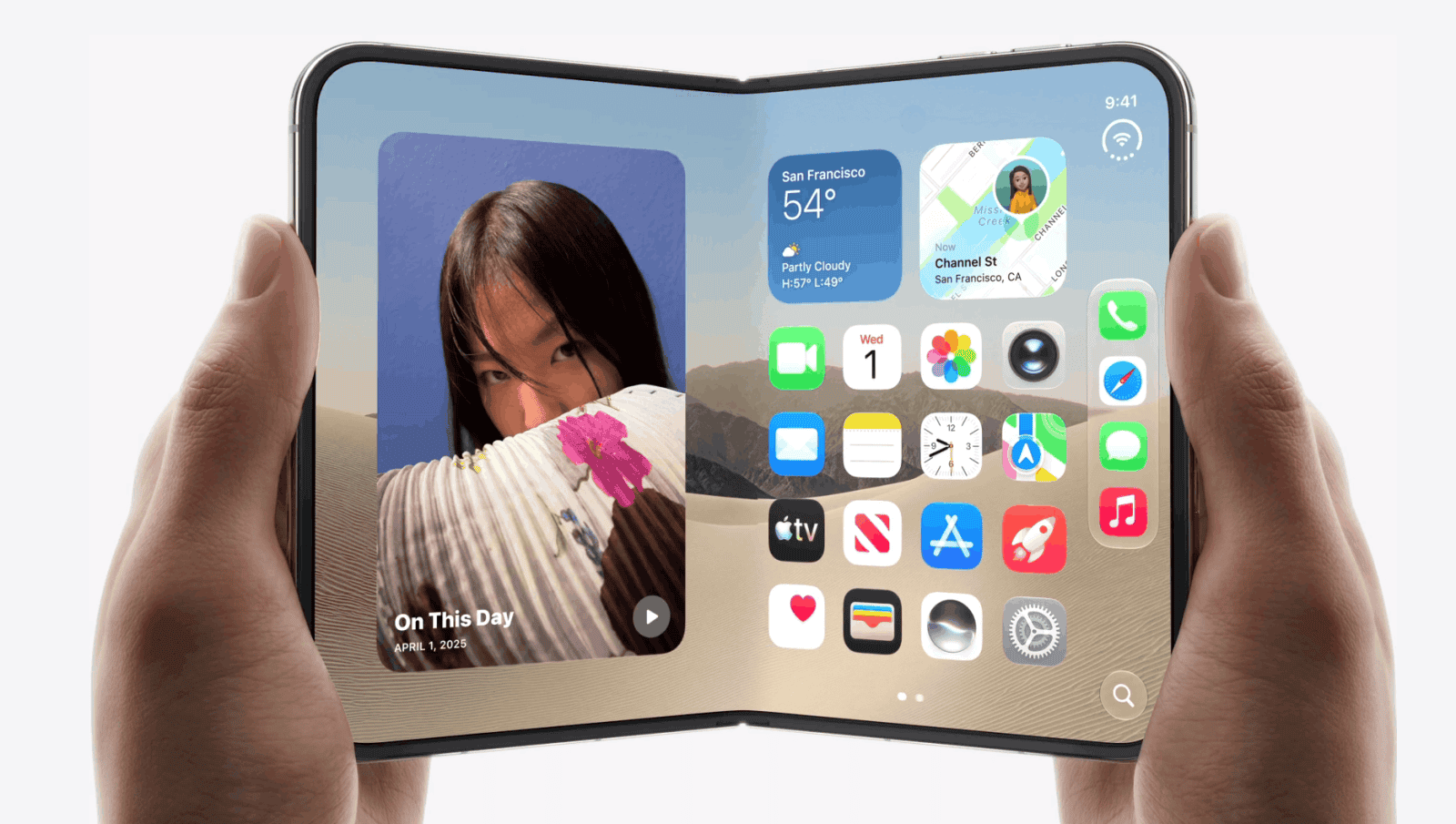
Pull the Duo out of your pocket and you’re greeted by a 5.4-inch outer display that matches the brightness, sharpness, and smoothness of any other Pro iPhone screen, though the phone itself feels notably stockier in hand. Rather than reworking the entire interface for the new form factor, Apple kept the familiar iPhone layout intact and instead relocated the dock and quick controls to the side of the outer screen, a subtle tweak that preserves the experience longtime iPhone users already know.
Open the device up, and the inner display is close to exactly double the size of the outer screen, allowing it to function like two stitched-together home screens. Multitasking works largely as expected for anyone familiar with foldables: apps open full-screen by default, but can be dragged to the side to trigger split-screen view, with a second app added alongside it. Dragging content between apps, such as pulling a photo directly into Messages, works fluidly, and tapping the divider between two open apps merges them into what behaves like a single unified app, complete with preserved window positions for later. A flex mode, similar to what’s found on rival foldables, lets users partially close the phone to unlock secondary controls in supported apps.
Refinement Over Reinvention
Rather than introducing entirely new foldable concepts, Apple appears to have taken a deliberately conservative approach, refining ideas that competitors like Samsung have spent nearly seven years developing rather than reinventing the format outright. That’s most visible in the build quality: the frame is titanium, and the hinge combines titanium with carbon fibre. While the hinge mechanism itself doesn’t feel especially groundbreaking, the phone was described as feeling unusually solid, helped by the fact that Apple didn’t prioritize ultra-thinness. At 5.2mm when unfolded, the iPhone Duo is noticeably thicker than Samsung’s comparable foldable, though it retains an IP68 water and dust resistance rating.
The inner display stood out as a particular highlight. Apple’s nanotexture coating dramatically reduces reflections, described as the least reflective smartphone display the reviewer had encountered. The fold crease is still technically present, but it’s barely perceptible, felt more than seen, marking one of the best crease-management implementations reviewed to date.
Other pleasant surprises included a three-speaker setup delivering immersive sound, a battery rated between 31 and 44 hours depending on which screen is active, comfortably ahead of last year’s iPhone 17 Pro’s 33-hour rating, and a vapor chamber cooling system despite the tight internal space constraints that typically force foldables to skimp on thermal management. Apple has also managed to retain MagSafe support, making the Duo only the second foldable on the market with magnetic charging, and confirmed Apple Pencil support arriving later this year.
Software Polish Is the Real Standout
According to the hands-on, Apple’s biggest advantage isn’t hardware, it’s software polish. Animations throughout the interface, including how home screens transition, depth effects when opening and closing the display, and even how the keyboard splits across the fold, were described as visually satisfying and unusually refined for a first-generation device. StandBy mode has also been integrated into everyday use: propping the phone up on a desk automatically switches it into a simplified, less distracting interface.
Apps also appear well-optimized across both screen sizes, defaulting to a larger, iPad-style layout with extra menus on the inner display, and switching to a compact phone layout when closed. Transitions between landscape, portrait, cover-screen, and multi-app views were called some of the smoothest handoffs seen on any foldable device to date, though that praise came with the caveat that most testing so far has been limited to Apple’s own curated app demos.
The Trade-Offs
Not everything impressed. The outer display reportedly lacks the anti-reflective treatment found on the inner screen, making it noticeably more prone to glare. The phone’s wide, passport-like shape also makes one-handed use awkward, with everyday actions like reaching for widgets or pulling down Siri feeling like an uncomfortable stretch. The relocation of volume buttons to the top of the device was also flagged as an odd choice.
Camera performance drew some of the sharpest criticism. The front-facing camera captures at 12 megapixels, compared to 18 megapixels on Apple’s standard bar-style iPhones, while the under-display inner camera was described as a clear weak point, with noticeably lower image quality and a visibly different screen texture where it sits. The rear camera system, meanwhile, includes only a main and ultrawide lens, missing the telephoto lens found on Pro models, putting its camera capabilities closer to the standard iPhone 17 than to a true Pro device. The Duo also forgoes Face ID entirely, relying instead on Touch ID built into the side button, and drops the Action Button found on other current iPhones.
The Verdict
Despite the trade-offs, the overall impression was strongly positive, with the Duo described as the most complete foldable experience currently available, even if it isn’t the iPhone most people should buy. For Apple, first entering a category Samsung has spent years cultivating, that combination of premium pricing, refined software, and calculated compromises appears to be exactly the strategy the company was aiming for.

I do marketing and tech things. Despite my profile picture, I don’t live my life in Instagram