Apple’s HomeView is more than another smart display. Reuters describes it as an important test of Apple’s AI strategy as it tries to close the gap with Amazon and Google while reinforcing its privacy reputation. This is a first look based on Apple’s announcement and Reuters’ reporting from the launch, not hands-on testing, but the design choices say a lot about where Apple wants to go.
Design and Hardware
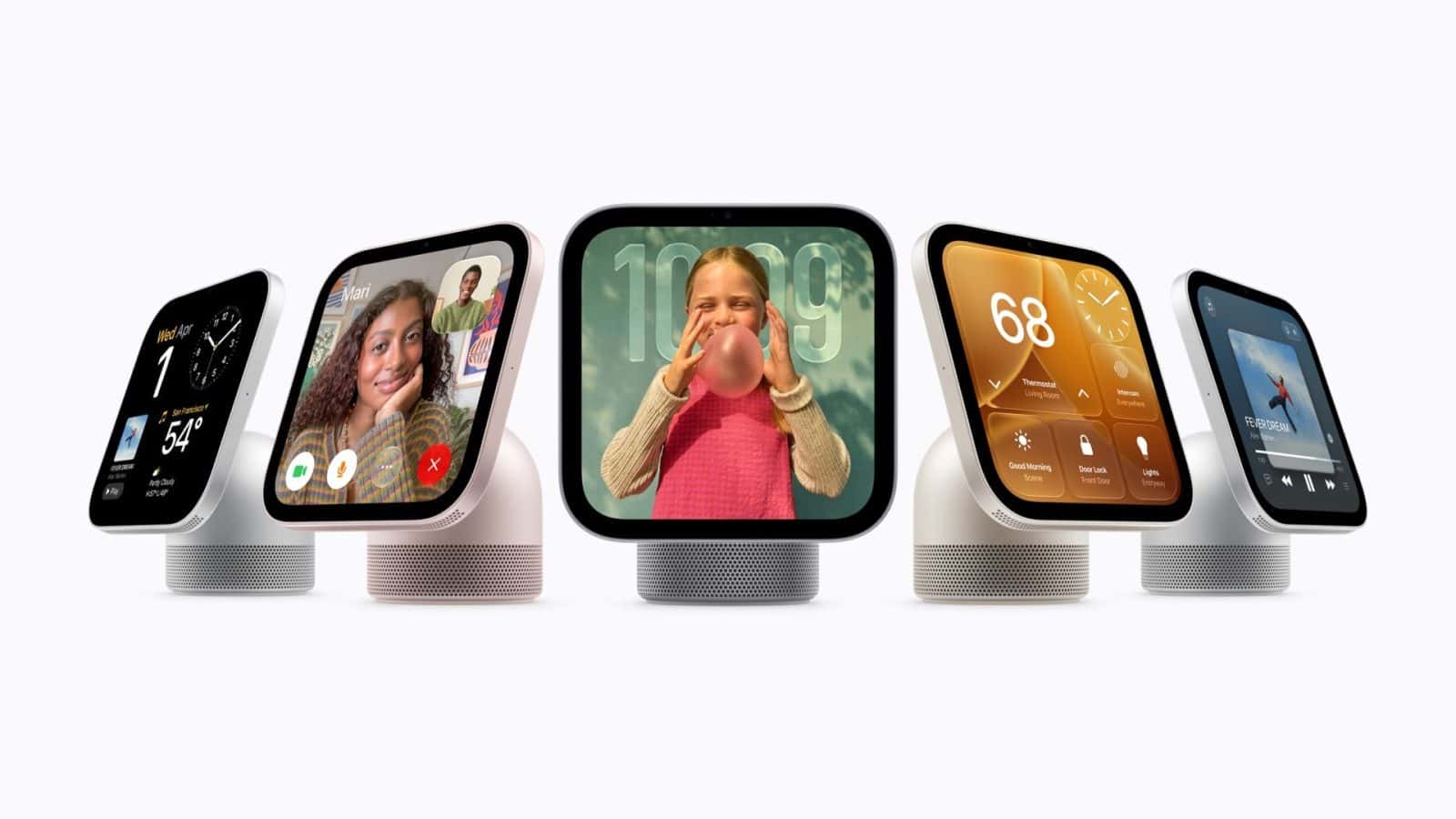
HomeView pairs a 7-inch Liquid Retina display with a domed speaker base, joined by a stainless steel hinge that tilts for tabletops of any height. It comes in silver, starlight, rose pink and space gray, each with a matching USB-C cable. Brightness runs from 500 nits down to 0.3 nits for nightstand use, and the interface shows simpler information from across the room, with more detail as you step closer.
A separate wall-mounted model comes in space gray and silver, using one of three Schneider Home mounts. The USB-C and AC-wired mounts start at $59.95 and $79.95, while a PoE version arrives in early 2027 at $129.95. Both models cost $299.
Audio and Entertainment
Audio is a strong point on paper. Two full-range drivers sit in the display, with a down-firing woofer and two passive radiators in the base, plus computational audio that tunes loudness and bass in real time. HomeView supports Apple Music with lyrics and animated art, Podcasts, News and Apple TV, along with compatible third-party apps. Handoff lets you continue a song by holding your iPhone to the screen, and multiroom audio works with HomePod, HomePod mini and AirPlay speakers.
Siri AI Takes Centre Stage
The real story is Siri AI, which Apple calls an entirely new, more conversational version of the assistant. Reuters reports that Apple demonstrated it recognising a user’s face and handling personal tasks, such as pulling a recipe from text messages, finding a nearby farmers’ market for missing ingredients and updating a shopping list. In another demo, a different family member stepped up, and HomeView switched to their data to check a friend’s early flight and start the coffee maker ahead of time.
That personalisation leans heavily on the iPhone. HomeView draws on a personal search index stored on the phone, which fits new CEO John Ternus’ view of the iPhone as an “intelligent personal hub”. As Apple’s Kaiann Drance put it, results come from the iPhone, so they are more relevant, timely and important to the user.
One notable philosophical difference is that Siri AI doesn’t end each answer with a follow-up question to prolong the chat. Apple’s Lilian Rincon said the company isn’t playing the game of keeping you engaged over many turns. That restraint is a welcome contrast to rivals.
Built for a Shared Space
A kitchen device has to serve several people, and HomeView recognises up to six faces, each with their own Home Screen and widgets. Reuters says Apple will decide whom to prioritise based on who last touched the device, among other factors, while features such as weather and thermostat controls stay open to anyone. How reliably that juggling works during a chaotic school-run morning will be one of the first things reviewers test.
HomeView also covers the basics well: FaceTime with Center Stage, Intercom, recipe conversion with hands-free timers, Find My and Live Activities. As a smart home dashboard, the Home Camera face shows up to nine live feeds, and it can detect smoke and carbon monoxide alarms. It works with the new Apple Home Collection accessories and Matter devices.
Privacy: Strong Claims, Real Fine Print
Privacy is where Apple is putting its weight. HomeView runs its own operating system on an A18 chip, and Secure Exclaves process camera and microphone data in a walled-off part of the silicon, inaccessible even to Apple. Reuters reports that no private data is stored on the device and that nothing is used for marketing, with Drance saying Apple isn’t building a marketing profile. Siri requests use on-device processing or Private Cloud Compute.
Two details are worth noting. Personal content only appears when the enrolled user’s face is recognised and their paired iPhone or iPad is present and recently unlocked. But Apple’s own footnotes say that if that phone drops off Wi-Fi, personal information may remain accessible under certain conditions, such as a recent connection to the same network. That is a reasonable trade-off, but it is less absolute than the headline suggests.
The Catches
HomeView works best with an Apple Intelligence-enabled iPhone or iPad. Without one, you still get Siri AI’s world knowledge, conversation and music discovery, but not the personal context that makes it special. Siri AI is also in beta on HomeView software 27.2, some server-based features have daily usage limits, and Apple says expanded access will be available for a fee in future. Camera intelligence needs an iCloud+ plan, and expressive Siri voices require recent iPhones or higher-spec iPads.
Availability is another limit. Pre-orders are open in Australia, Canada, India, New Zealand, the UK and the US, with shipping from 13 November, plus Singapore and South Africa through slightly different routes. It is not on sale in the EU, because Siri AI is currently unavailable in iOS there.
Verdict
At $299, HomeView is a compelling pitch for Apple households: a well-built, good-sounding hub with a genuinely different approach to personal AI and privacy. Its value depends on owning the right iPhone and trusting a beta assistant. If Siri AI delivers in everyday use, HomeView could finally give Apple a credible answer to Amazon and Google at home. Wait for hands-on reviews to see whether it does.
Via: Apple Newsroom: Meet Apple HomeView

I do marketing and tech things. Despite my profile picture, I don’t live my life in Instagram